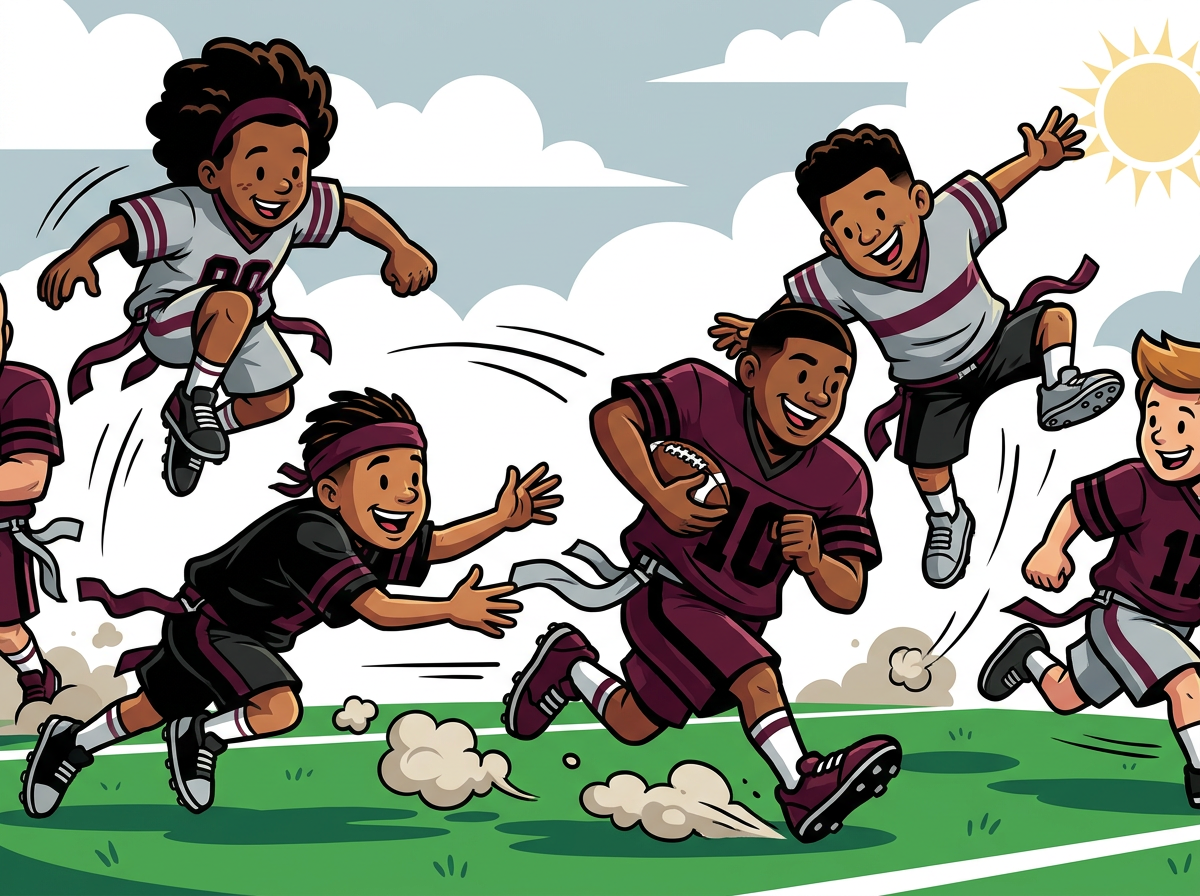

Foothills Falcons Football Program
Flag Football
Coaches Manual
Spring 2026 — Grades 1 through 8. Everything you need to coach, inspire, and develop young athletes the Falcons way.
“Same Mud. Same Blood.”
Welcome, Coach
Thank You for Volunteering
Over the weeks of your involvement you will find this to be a very rewarding and fulfilling endeavor. It is not without its challenges, but if you have patience and understanding of what we are trying to accomplish, you will have a great time teaching these kids the sport of football.
Goals of the Program
Just Play Football
Thirty years ago kids used to go to the park with their buddies to play pick-up football. The first goal of this program is to give today's kids a chance to run, throw, catch, and just play football. There will be competition — we keep score and standings — but winning isn't the main goal. Getting a chance to play is. That should be first and foremost in your thoughts as a coach.
Physical Literacy
Introduce basic physical literacy to the kids — the fundamental skills of running, catching, and throwing.
Create Future Football Fans
The CFL and other levels of the game are constantly fighting for the attention of young people. We want to build a love for the game that lasts a lifetime.
Structure
League Set-Up
Novice Division
- • Grades 1-2 and 3-4
- • 5 vs. 5 on the field
- • Coach plays Quarterback
- • Max 10 players per roster
- • 50 athletes per division cap
Atom Division
- • Grades 5-6 and 7-8
- • 6 vs. 6 on the field
- • Player Quarterback
- • Max 12 players per roster
- • 50 athletes per division cap
Key Setup Notes
- 1Players will attend an Evaluation Day to assess primary skills (Running, Catching, Passing). After evaluation, players are divided evenly across teams.
- 2Roster size of 8-12 players per team. Small enough to rotate easily, large enough to cover absences.
- 3ALWAYS have an even number of teams. No byes or weeks off. If you need to lower roster size to 6-7 to create another team, do it.
Coaching Tips
Pitfalls to Watch Out For
Attention Spans Are Short
It won't take much to distract them. The directions in this manual will help — take them to heart.
You're a Coach, Not a Babysitter
Everyone likes being adored by kids, but you cannot spend practice time as a glorified jungle gym. The more you deal with this early on, the better success you'll have.
Expect Some Tears
An errant pass, non-inclusion, tripping — all can open the floodgates. Show care and concern first. Guide them to their parents or the League Coordinator if needed. Check back and encourage them to return.
Be Committed
If you don't show up, your team doesn't function. If you must miss a session, find a substitute and inform the League Coordinator.
Spread the Ball Around
Finding your fastest player and giving them the ball constantly is a quick way to ensure success — but it's in opposition to the intent of the program. Get everyone involved. Let the wins and losses take care of themselves.
Logistics
Field Set-Up
The flag program can be set up on any standard Canadian Football Field. All you need is a set of pylons to mark off a smaller playing area. Up to four games can be played on a standard field — two games going in one direction and two in the other.
Playing Area
30 yards wide by 45 yards long with a 10-yard end zone
Start of Play
Ball scrimmaged from the 45-yard line going in to start each series
Ball Placement
Ball brought to mid-field every time prior to the start of each play
Throw Box
Final 5 yards to the end zone — the ball MUST be passed from this point in, even if the offense has run plays remaining
4 games fit on a standard CFL field
Official Rules
Rules of the Game
1Game Structure
Teams play a “baseball inning” style game each team gets 5 offensive plays to score from the 45-yard line.
Regardless of scoring, teams get all 5 plays before turnover.
All players must be in the game by the 3rd play and play a minimum of half the plays.
Practice: 45 minutes, followed by a 10-minute break, then approximately 60 minutes of game play.
At Novice: a coach from each team plays Quarterback. No snap from Centre required.
At Atom: players play all positions including Quarterback.
Minimum passes per inning: 2 at Atom level, 1 at Novice level.
2Flags, Belts & Uniform
Flag Belts
Three regulation flags on an official belt
Flags must hang on the outside of the jersey
Flags may not be rolled.
Uniform
- Official game t-shirt at every game
- Running shoes or rubber cleats (min 7 studs)
- Shirts MUST be tucked in or inside flag belt
- No caps/hats (except religious headgear)
- No hard or plaster casts
3Tackling & Contact
A tackle is made by removing the flag belt of any player advancing, holding, or carrying the ball.
If a ball carrier's flags fall off while running, the defense must touch the ball carrier anywhere to down them.
No charging running into another player to avoid being tackled, to make a tackle, or to block.
No stiff arming extending arm to hold off or push away defensive players.
No blocking players must not impede the progress of defenders to the ball carrier. Penalty: ball placed at the infraction.
4Offensive Rules
No kickoffs. Ball placed at the 45-yard line.
No punts. Teams get 5 plays per inning, then turnover.
No play can start from further back than the 45-yard line. Any loss/penalty beyond that resets to 45.
Up to two offensive coaches in the huddle. Once huddle breaks, coaches must be 5 yards back.
10 seconds to return to huddle after a play. No strict play clock, but abuse will be dealt with at the league level.
No player can receive a hand off more than twice per series.
The QB can only run once per series. Other 4 plays must be hand offs or passes.
Inside the 5-yard THROW ZONE: the ball MUST be passed downfield.
5Defensive Rules
All defensive players must be at least 5 yards off the line of scrimmage.
A defensive coach may line up the defense, then back up 15 yards before the snap.
Atom Level Only Rushing: Rusher(s) lined up 5 yards back (marked by a bean bag) may rush the QB across the line of scrimmage after the snap. They can only rush once per inning.
Non-rushing players cannot cross the line until the ball has left the QB's possession.
Once the ball is handed off, all defenders may rush the ball carrier.
6The Ball is Dead When
7Officiating
Coaches double as officials offensive coaches call offensive penalties, defensive coaches call defensive penalties and spot the ball.
Strictly done on the honor system. Only basic penalties: procedure, holding, tackling, and BLATANT pass interference.
Unsportsmanlike behavior: Abusive language or taunting is immediately called. Second offense = removed from competition. Third offense = possible ban from the league.
All penalties are 5 yards from the infraction.
Coach decides to accept or decline penalties. Accepted defensive penalties: assessed as charged, no replay. Accepted offensive penalties: assessed as charged, down replayed.
Competition
Scoring & Standings
Scoring
All scores are worth 1 point.
No converts, field goals, or rouges.
The only way to score is to cross the goal line.
Standings & Playoffs
Teams placed by win/loss record.
Tiebreakers (in order):
- Head-to-head result
- Points against
- Points scored
- Coin flip (or drawing of straws for 3+ way tie)
Pass Eligibility & Receiving
All players are eligible to receive a pass, including the quarterback (if the ball has been handed off, tossed, or pitched behind the line of scrimmage).
Player must have one foot in bounds when making a catch.
An incomplete pass behind the line of scrimmage = fumble. Play is dead at the spot of the incompletion.
Interceptions: Play is dead. Ball returns to the 45-yard line. No points awarded.
Skills Book — Level One
8–10 minutes per skill during practice time
Passing
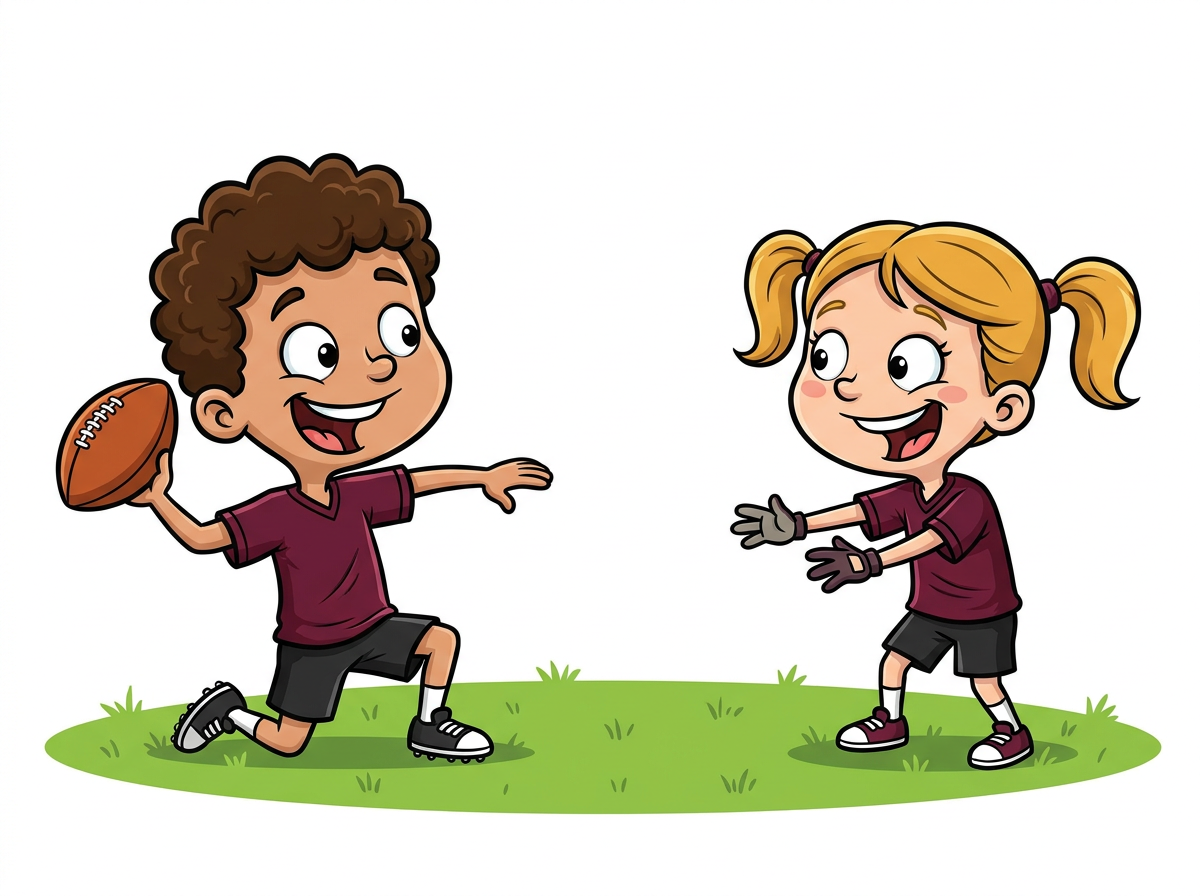
Passing Release
Players on one knee throw back and forth, 3–5 yards apart.
Focus: Ball held at ear with two hands before release. Counter-clockwise rotation of hand as ball is released. Passing arm should point towards receiver after delivery.
Progression: Move to standing position and add stepping into the pass. Opposite foot from passing arm steps towards receiver as ball is released.
Catching
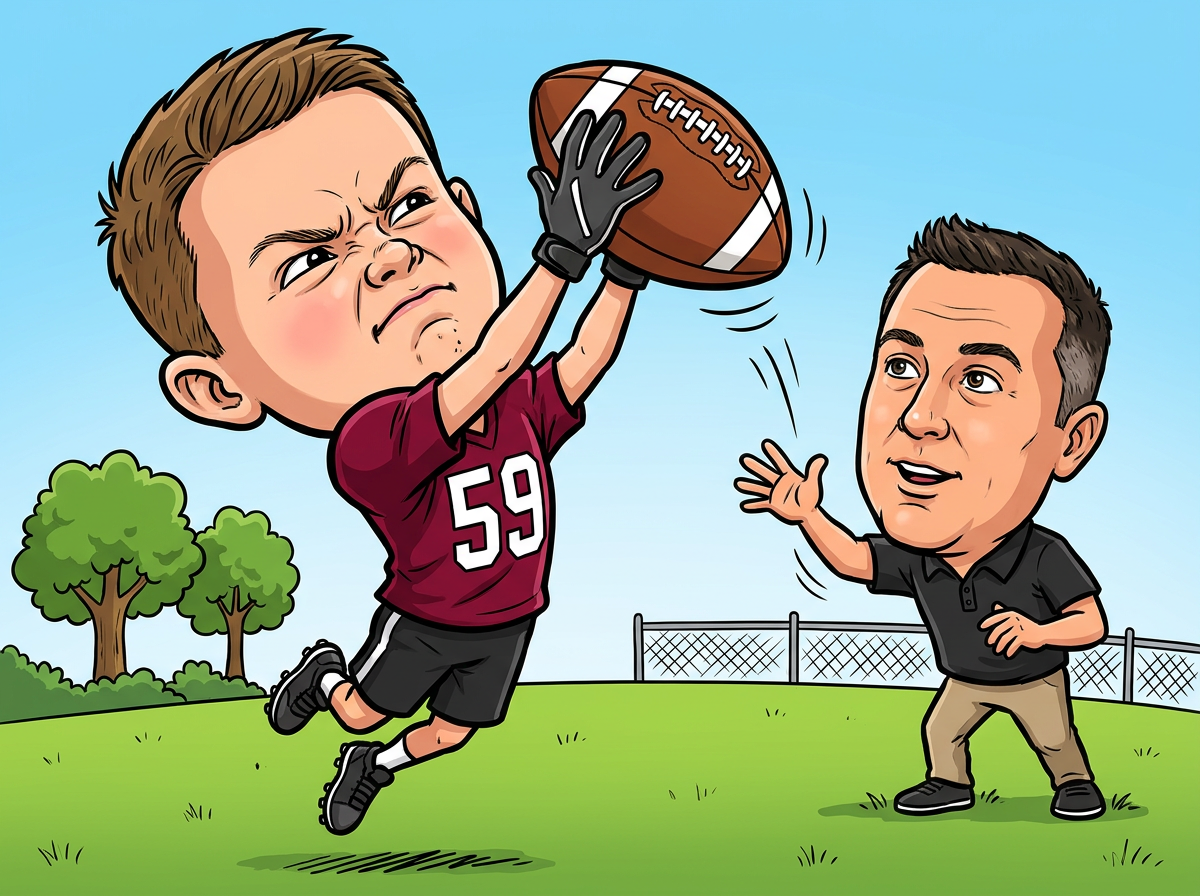
1. Straight Ahead Catching
Facing the coach and standing still, player is tossed the ball.
Focus: Catch with the hands. Pinkie fingers together on a low pass, thumbs together on a high pass.
Tuck away: Ball secured beside the body, even with the forearm, covered at its tip by the hand. “Look the ball in” all the way to the secured position.
2. Sideways Catching
Facing sideways with head turned towards the coach, standing still. Same catching techniques apply.
Repeat drill turning the other way.
Running
1. Running Drills
2. Taking a Handoff
Players are handed the ball by the coach standing still.
Arm positioning: Arm closest to the coach/QB should be up, other arm down to cradle the ball. Allow the ball to touch the torso before “grabbing” it.
Transfer to the “tucked away” position. Progress to a 3–5 yard run before the handoff.
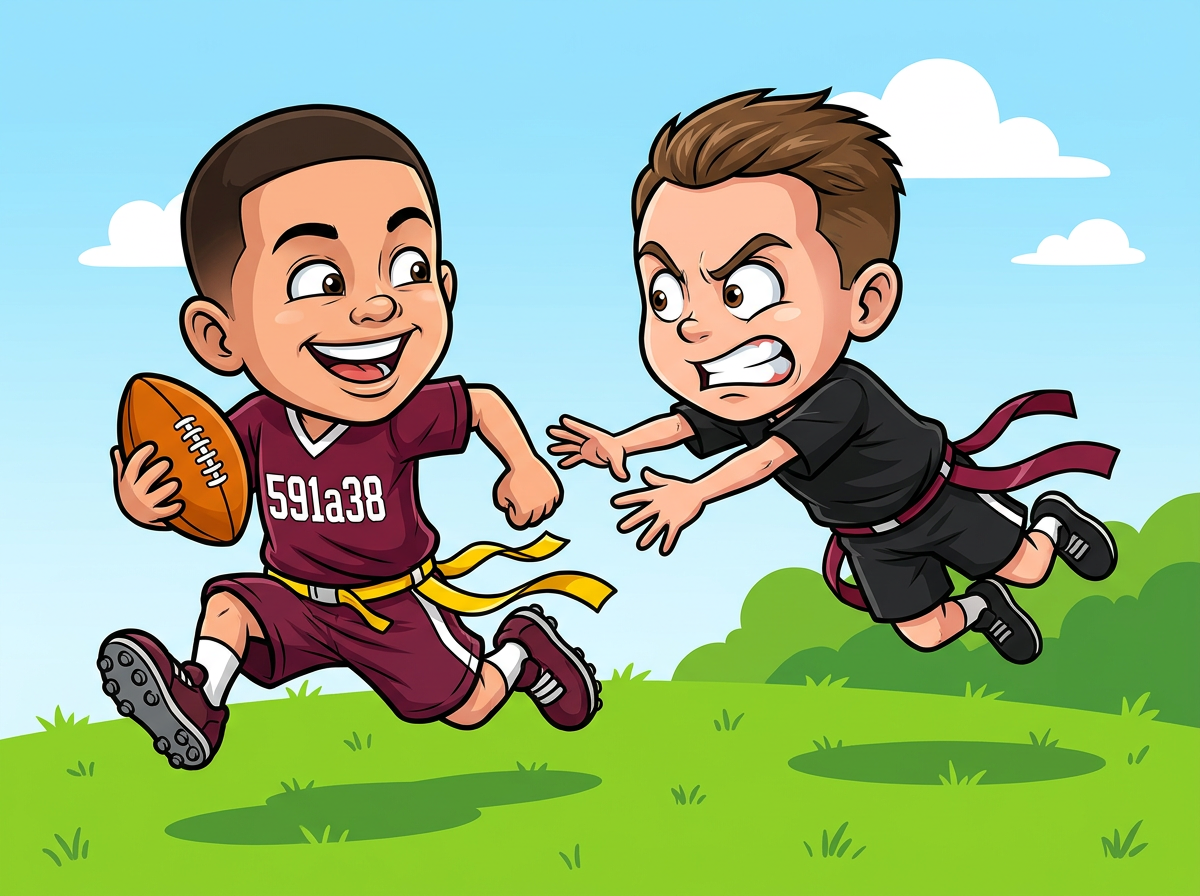
Tackling / Flag Pulling
1. Breakdown Stance
Players in a semi-circle around the coach. Model proper breakdown stance: torso straight, bent knees, head up, arms in ready position. Hold for a few seconds to get used to it.
2. Flag Pulling
Players paired off, face each other a yard apart. Player A steps to one side. Player B (in breakdown stance) steps with them and removes a flag. Repeat three times to each side, then switch.
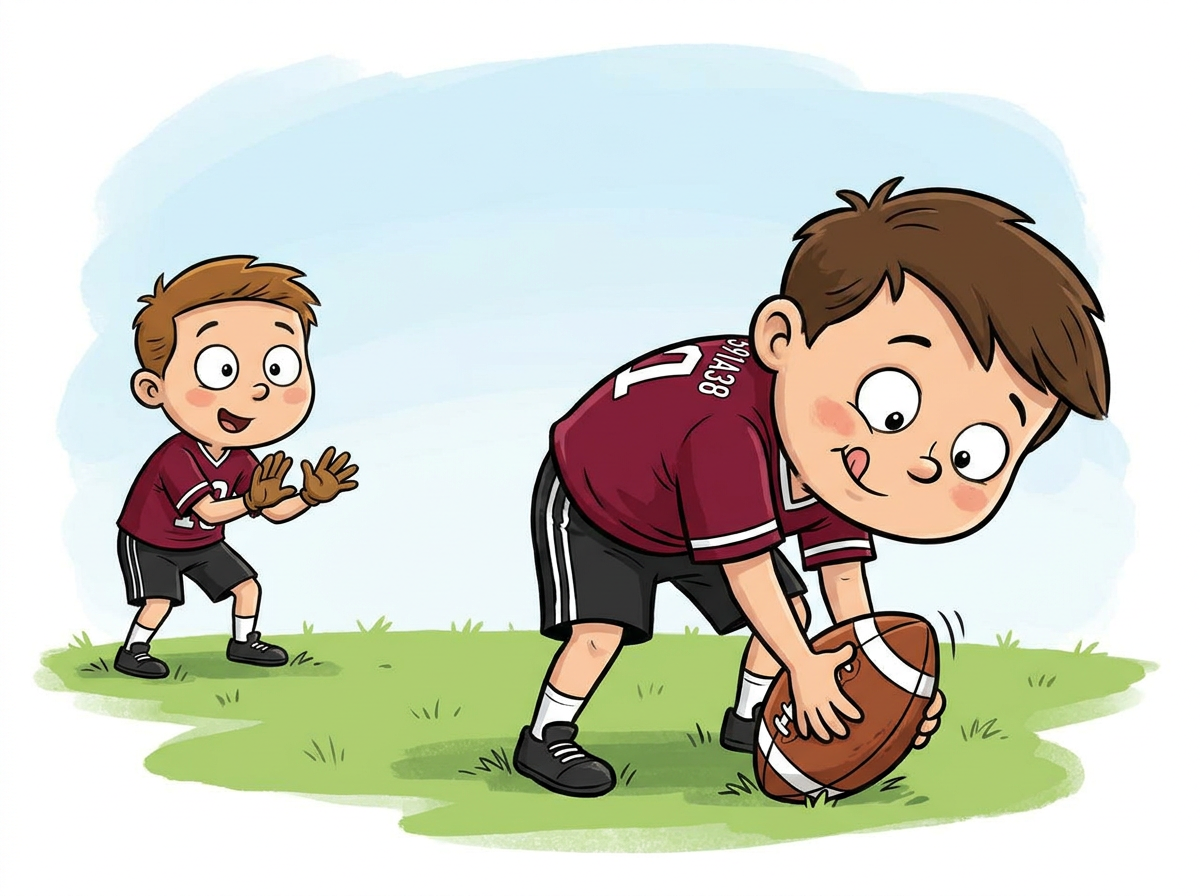
Long Snapping
1. Straight Snap
Players paired off, take turns snapping directly to their partner through their legs. Not a long snap — just the start of the process. Repeat 5 times per partner. If your team is really struggling, use the straight snap for the time being.
2. Long Snap
In pairs, players attempt to snap to their partner 3–5 yards behind them. This is a tougher skill. Patience and encouragement are crucial. Passing techniques may help (throwing through the legs). For game purposes, note which players can do this and only allow those with a chance of success to attempt it initially.
Skills Book — Level Two
8–10 minutes per skill during practice time
Passing
1. Passing Release (Review)
Continue one-knee and standing drills from Level 1. Focus on ear position, counter-clockwise rotation, follow-through pointing at receiver.
2. Drop Back (NEW)
Add the concept of a three-step “drop.” From a breakdown position with the ball, players drop back crossing over their feet while the head remains looking downfield, set their feet, then throw.
Catching
1. Straight Ahead Catching (Progression)
Same techniques as Level 1. Add the concept of running forward to catch the ball (as in a Hook pattern), then turning and running once they've caught and tucked it away.
2. Sideways Catching (Progression)
Facing sideways, head turned towards coach, now running forward while being tossed the ball. Same catching instructions. Repeat turning the other way.
Running
1. Running Drills (Progression)
Sprint: try to keep shoulders down and head up.
2. Taking a Handoff (Progression)
Players now receive the ball from the coach coming from 3–5 yards behind them. Same arm positioning. New emphasis: keep the head up and don't look for the ball. Trust the coach to place it on the torso, then grab.
Tackling / Flag Pulling
1. Breakdown Stance (Progression)
Same semi-circle drill. Now hold the position for 10 seconds and “motor” (run in place) while doing it.
2. Flag Pulling (Progression)
Players in a line. Player A stands 5 yards out facing Player B. Player B runs at a 45-degree angle forward and away. Player A starts by motoring feet, moves to cut off Player B, and removes the flag. Repeat twice to each side, then rotate.
Long Snapping
Continue long snap attempts to partner 3–5 yards behind. Patience and encouragement remain crucial.
Continue noting which players can do this for game purposes. If your team is really struggling, continue using the straight snap.
Skills Book — Level Three
5–7 minutes per skill during practice time
Passing
1. Drop Back (Review)
Continue three-step drop from breakdown position. Cross feet, head looking downfield, set feet, throw.
2. Leading the Receiver (NEW)
Players now throw to a moving target. As they drop back, their partner runs left or right. The QB must “lead” the player by passing in front of them. Emphasis on stepping towards the throw point and finishing with a follow-through in that direction.
Catching
1. Straight Ahead Catching (Progression)
Running forward, catch the ball (Hook pattern), turn and run. All previous techniques apply — hands, pinkie/thumb positioning, tuck away, look the ball in.
2. Sideways Catching (Review)
Facing sideways, running forward, catch from the side. Repeat both directions.
3. Streak Catching (NEW)
From a spot on the line of scrimmage 5 yards from the coach, the player runs forward and catches a ball on the run. The most important skill here: continuing to run while the ball is being passed to them.
Running
1. Running Drills (Review)
2. Taking a Handoff (Progression)
Same as Level 2. As they run forward and receive the ball, another coach points to one side or the other to make the player run around them. This emphasizes keeping the head up.
3. Receiving a Pitch (NEW)
Player lines up 3 yards behind the coach and runs sideways to receive a pitch. All catching techniques apply, especially continuing to run while the pitch is on its way.
Tackling / Flag Pulling
1. Breakdown Stance & Flag Pull (Review)
Continue Level 2 drills: 10-second hold with motoring, 45-degree angle pursuit and flag pull.
2. Gauntlet (NEW)
A 10-yard by 10-yard square is created with pylons. All players placed inside. On the whistle, they pull as many flags as possible before their own flag is pulled. Once your flag is pulled, you're out. Continues until the last person standing. Repeat if time permits. Be wary of possible collisions.
Long Snapping
Continue long snap attempts. This remains the toughest skill. Patience and encouragement are crucial regardless of outcome.
Continue noting successful snappers for game purposes. If your team is still struggling, continue using the straight snap.
Xs and Os
Playbook
Offensive and defensive formations for game day
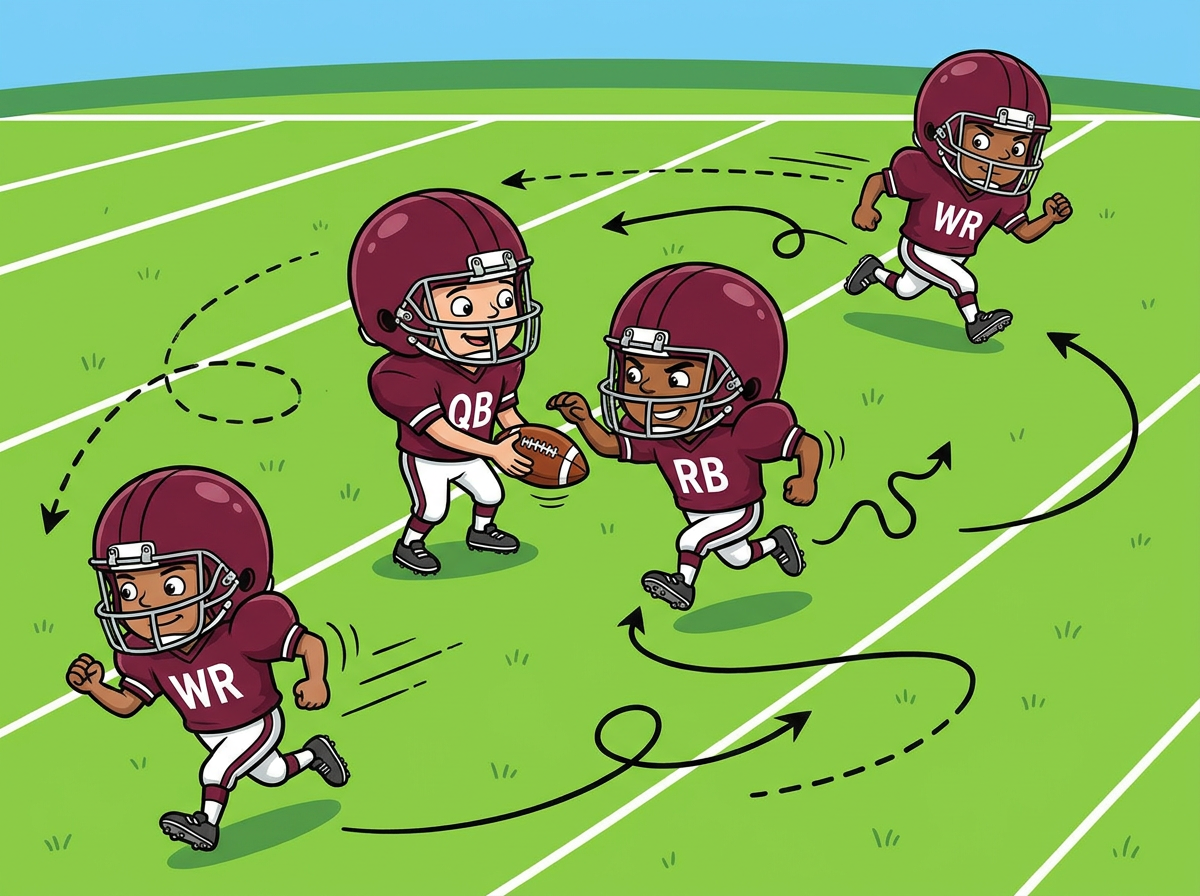
Offence
Standard Set
QB can line up “under” the Centre to receive the snap or in “Shotgun” formation 5 yards behind the Centre. A coach should train each player at every position.
Running Plays
Base Play
- • RB crosses the backfield for a hand-off or fake
- • Left WR runs a post
- • Right WR runs a fly
- • C snaps ball then runs a short buttonhook
Draw
- • All receivers take off downfield (All Go look)
- • RB delays, then takes the handoff from QB
- • RB runs downhill and looks for the best path
Passing Plays
Hooks
- • Both WR and RB run 5–7 yards, stop, rotate, come back to the ball
- • C takes 2 steps to the side before running to avoid RB's area
- • Distance determined by QB arm strength and defense
All-Go
- • Used to stretch the defence
- • All players run straight go pattern downfield
- • Look for the ball over inside shoulder after 10–12 yards
- • C takes 2 steps left for spacing
Curls and Outs
- • Each WR runs a curl pattern towards the middle of the field
- • Begin to curl around 8 yards, ending up facing the QB
- • RB and C run “out” patterns at 5–7 yards
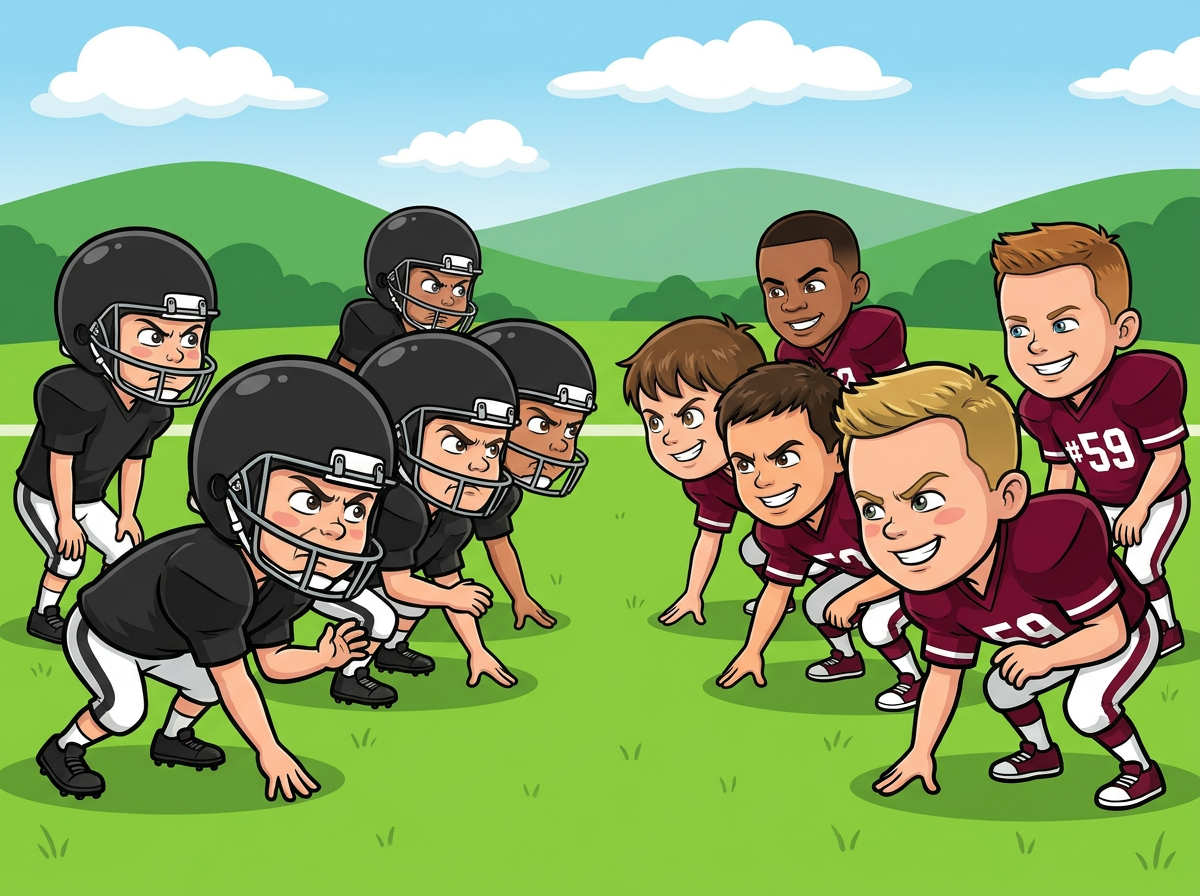
Defence
Person to Person
Often used initially. Each DB is lined up against an offensive player with similar speed and ability.
2-2 Zone with a Rusher
Rusher puts big pressure on the QB. 2 DB cover short, 2 DB cover long. Best when offence is near a first down or touchdown.
3-2 Zone (No Rusher)
Strongest against short passes and hand-offs. Three defenders cover the short zone, two cover deep.
2-1-2 Zone (No Rusher)
Relatively balanced and tight toward the inside/center of the field. Offence can try to run or pass to the outside.